What to visit in Salento
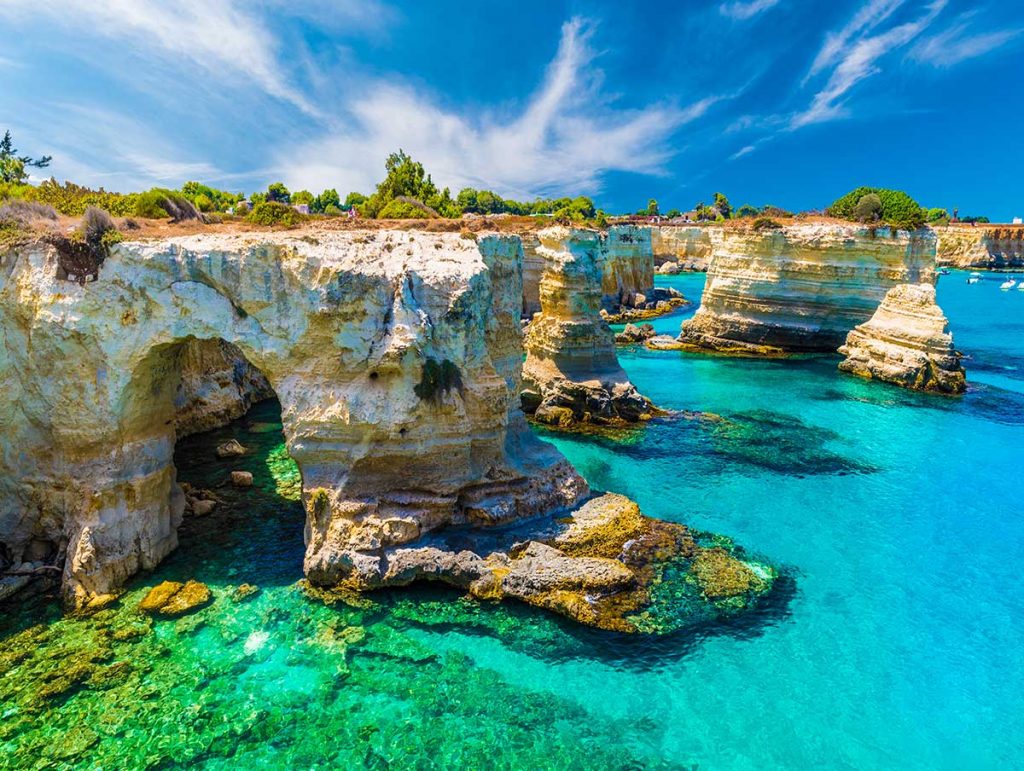
In the last 15 years, Salento Leccese has become the most famous seaside destination in Italy. What drives so many people to reach the heel of Italy, this narrow strip of land divided between the Ionian and the Adriatic? The first reason is obviously the beauty of the sea, crystal clear as it can only be found in a few other places in the Mediterranean.
Here are some of the most beautiful beaches in the world: Punta Prosciutto, Punta della Suina, Porto Selvaggio and others, not surprisingly, all have names that refer to the Maldives and the Caribbean. The second reason is the hospitality of the Salento people, a people who have experienced the centuries-old encounter with all the other cultures of the Mediterranean whose echo we can still hear today in the architecture, language, music and cuisine.
Then there are the villages, some very famous, even too much, like Otranto and Gallipoli, stormed in July and August and to be enjoyed a bit out of season. Then there are the less famous ones, but true stone scenographies not to be missed: Galatina, Nardò, Specchia, they are not the first thought of the tourist in Salento but they deserve more than a few days of attention.
Obviously there is Lecce, capital of the Baroque, a marvel of stone. And it is from here that we want to start our trip to Salento, going down the Adriatic coast and then going up the Ionian.
On this page we recommend the 10 things to do and see absolutely during a weekend or a holiday in Salento.
Lecce
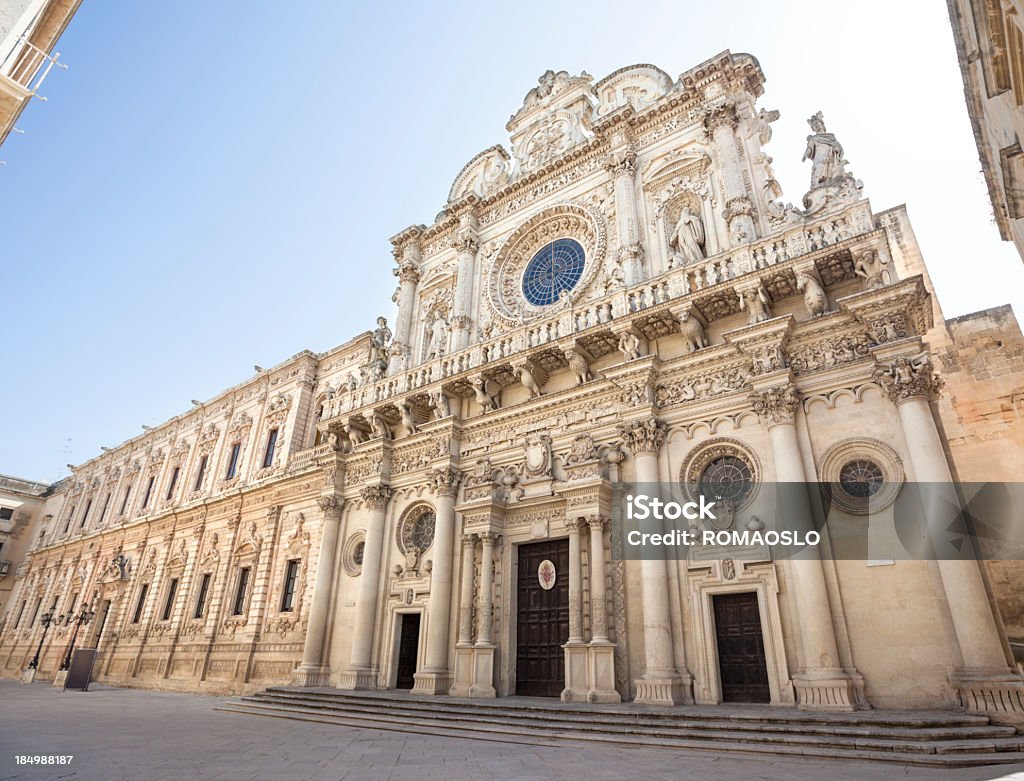
Lecce is primarily a baroque city, which here is expressed like never before in any other city, exploding in a very particular and specific declination, to the point of deserving the name of Lecce Baroque.
Bright decorations that enrich the cladding of buildings, the intense colors of Lecce stone: a soft and compact limestone, with warm and golden colors that lends itself very well to being worked with the stonemason.
Baroque art spread to Lecce in the seventeenth century, during the Spanish domination, replacing classical art and creating a style that left room for fantasy and imagination. The historic center is full of examples of the processing of this stone in monuments, churches but also balconies and terraces of private homes.
But it is not only the Baroque that characterizes Lecce: hospitable, orderly, with a very intense nightlife, Lecce is the ideal place to complete a seaside holiday in Salento.
Otranto
Leaving Lecce, taking the coastal road that runs along the Ionian Sea, you come across Otranto, the easternmost point of Italy. Albania is right in front of you and on some clear days it almost seems you can touch it.
The ancient village is dominated by the outline of the Castle, the place where the first Gothic novel in Europe was set, entitled precisely “The Castle of Otranto” by Horace Walpole. Built between 1445 and was commissioned by Ferdinand of Aragon to defend this important port that for millennia had been the object of invasions and aims, from the Messapians, to the Greeks, to the Romans and up to the Turks.
The ancient village of Otranto unfolds around the castle, a tangle of streets, alleys, views, elegant buildings, churches and flower-filled balconies.
A place from another time, especially out of season, when the tourists leave and only a few inhabitants remain. Not far from the Castle is the Cathedral of Santa Maria Annunziata, the cathedral of Otranto.
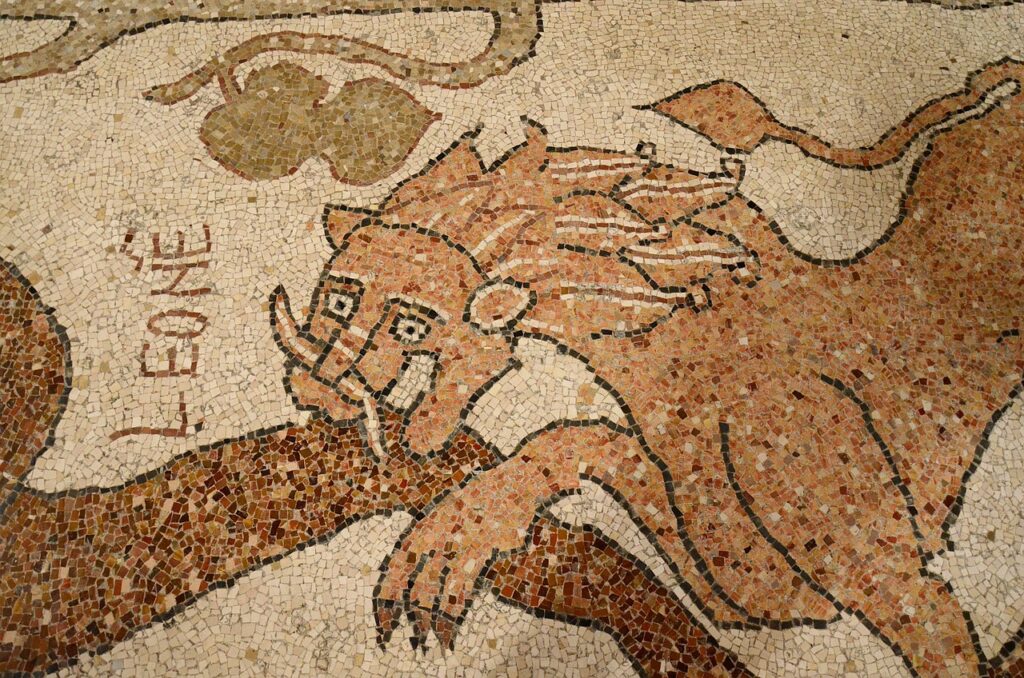
An extraordinary religious monument for three reasons: the large mosaic on the floor that draws a gigantic Tree of Life, created by the monk Pantaleone between 1163 and 1165.
The mosaic tells stories from the Old Testament and profane stories, such as the cycle of the Knights of the Round Table, the signs of the zodiac, legends and symbols of men’s work. The second motif is the ossuary in the Cappella dei Martiri.
Here are collected the remains of the 800 inhabitants of Otranto who in 1480 opposed the religious conversion desired by the Turks who conquered the city. Behind the altar is the stone used for their beheading. It is no coincidence that Otranto is also known as the “City of Martyrs”.
Third element, the underground Crypt with 42 columns that divide 5 naves. In Otranto there are some of the most beautiful beaches in Salento: 1.5 km north of the Baia dei Turchi, a Caribbean beach that can be reached after passing a beautiful pine forest.
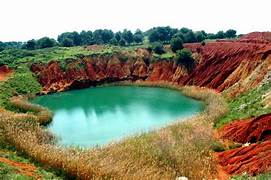
Here we are in the Riserva degli Alimini, two lakes of fresh and salt water, an extraordinary place where nature is still lush and protected. Heading south, instead, near Santa Cesarea, there is the Bauxite quarry, a lunar and desert-like landscape and 5 km further down the Punta Palascia lighthouse, a postcard-like place of Otranto.
Santa Cesarea Terme
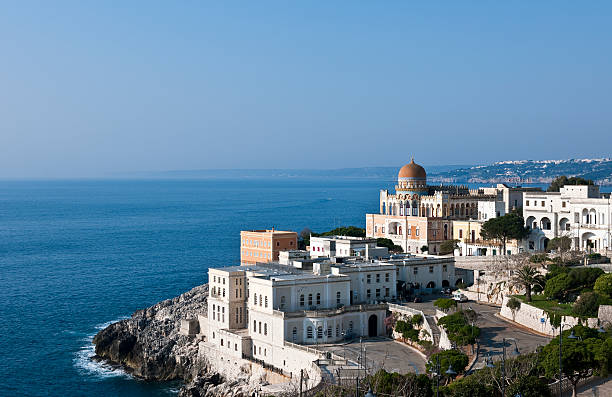
Let’s start with the name: Santa Cesarea Terme betrays the thermal vocation of this corner of Salento. According to legend, here Hercules concluded his battle with the giants whose rotten bodies generate the typical smell of sulfur and the hot water used for the spa.
In reality, the waters come from four natural caves (Fetida, Sulfurea, Gattulla and Solfatara) and are famous for their healing and healthy properties.
The spa complex consists of a hotel, a thermal pool and the Caicco lido. Next to the spa is the most beautiful and scenic building in Santa Cesarea: Villa Sticchi, the first thing you notice when you arrive in the town of Salento.
Built at the beginning of the 1900s by order of the engineer Giovanni Pasca: the purple-red dome, the decorations, the columns and the double staircase at the entrance are reminiscent of a piece of the Orient in Puglia. Admission is free.
Along the main road of Santa Cesarea you can also admire Villa Raffaella, built in the same period in Liberty style. Santa Cesarea is a steep village full of stairs that lead to the upper part. We recommend getting there with the walk through the Aleppo pines that leads to the viewpoint over the sea.
Along the coast, in search of beaches, you can notice the numerous watchtowers built by Charles V to defend the coast from invasions. Among these, the most beautiful is Torre Miggiano, which can also be reached for the wonderful cove where you can dive.
Santa Cesarea has mostly beaches with cliffs, therefore not suitable for those who cannot swim and love sand with shallow waters. However, just a few kilometers towards Otranto are enough to find some of the most beautiful and quiet beaches in Salento.
Castro e Marina di Castro
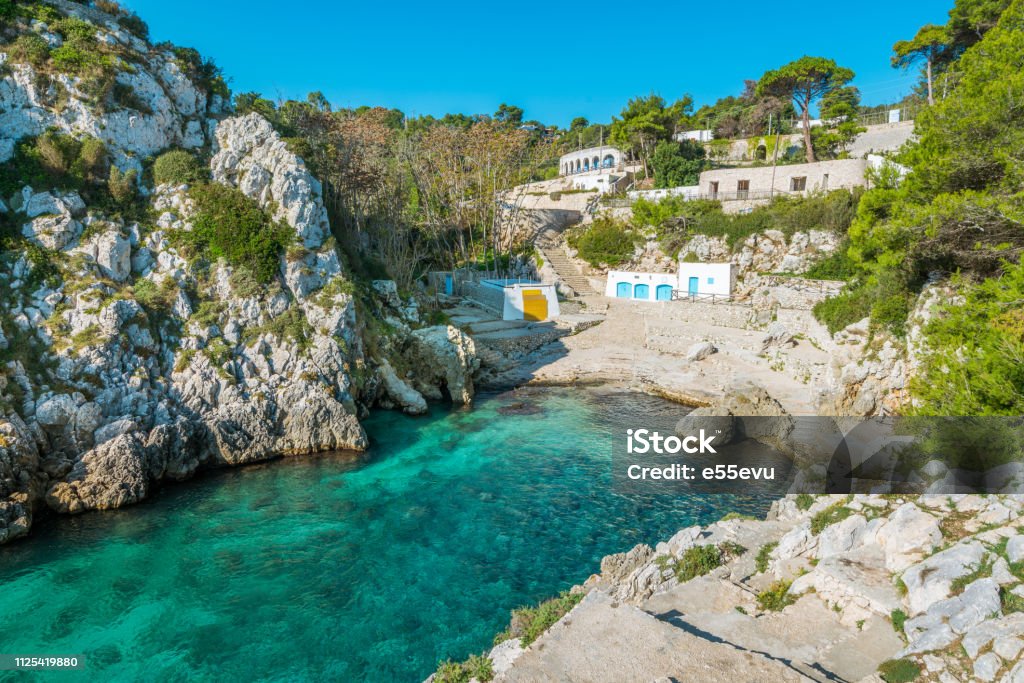
As Virgil tells in the Aeneid, the Trojan hero landed in Italy along the coast of Castro, which was then called Castrum Minervae, due to the presence of a temple dedicated to Minerva.
For a long time it was thought to be a legend, until the discovery a few years ago of an enormous statue of Athena and the bronze statuette of the Trojan Athena.
The works, along with much more, are visible in the Archaeological Museum set up in the Castle, a true symbol of the city of Salento (entrance €2.50). The castle is located on the top of the hill. The current structure is the Aragonese one, built on the remains of the Byzantine fortress destroyed by the Turks in 1500.
A large rectangular internal courtyard has, over the centuries, housed the artisanal and agricultural products that Castro sold throughout the Mediterranean.
The castle overlooks Piazza Armando Perotti, which offers a magnificent view of the sea. From the castle you descend into the ancient town of Castro, a village full of palaces, alleys and churches.
Among these, the main one is the Church of the Annunziata built in 1171 on the remains of a Greek temple.
Going down towards the sea you come across Castro Marina, the newest part of the Apulian town. One of the most exclusive places in Salento, with white houses overlooking the sea, deep blue water, restaurants and entertainment venues. The sea is wonderful and just a few steps away, but if you are looking for beaches and shallow waters, it is better to change direction.
The sea of Castro Marina is deep and rocky and this explains its beauty. However, 1 kilometer from the center there is Acquaviva, one of the most beautiful inlets in Salento easily accessible to all.
Along this very jagged coast, the Zinzulusa is worth a visit, a cave that can be reached on foot with a special path. The name comes from zinzuli which in the local dialect are the rags that the numerous stalactites present resemble.
Specchia
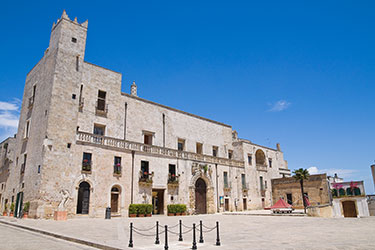
Specchia is one of the most beautiful villages in Italy and cannot be missed from any itinerary in Salento.
If you have ever seen a photo of the village, it has certainly happened, it certainly portrayed the profile of Castello Risoli, in Piazza del Popolo and the heart of the village. This palace occupies the space of an ancient fortified castle around which the village of Specchia was later born.
Only in 1500, by will of the Protonobilissimi marquises of Specchia, was it transformed into a noble palace.
Another less visible jewel of Specchia is the underground road that winds along the historic center.
In this network of tunnels there are four ancient hypogea that for centuries were used as oil mills: Scupola, Cicca, Perrone and Francescani neri, which testify to how Specchia was one of the main centers of Apulia for the production of olive oil.
These mills were dug three meters below ground to maintain a constant temperature of about 20 degrees, ideal for separating the water from the oil during pressing. The underground mills can be visited thanks to guided tours organized by the local Pro loco.
The most important religious monuments in Specchia are the Mother Church dedicated to the Blessed Virgin but, above all, the Convent of the Black Franciscans.
The 16th century church has a beautiful chapel dedicated to Saint Catherine, entirely decorated, and a crypt with 36 small columns. If the summer heat is a bit oppressive, it is a good idea to take a walk in the Bosco Magnone, a pine forest of about 500 trees including Aleppo pines, holm oaks and domestic pines.
Santa Maria di Leuca
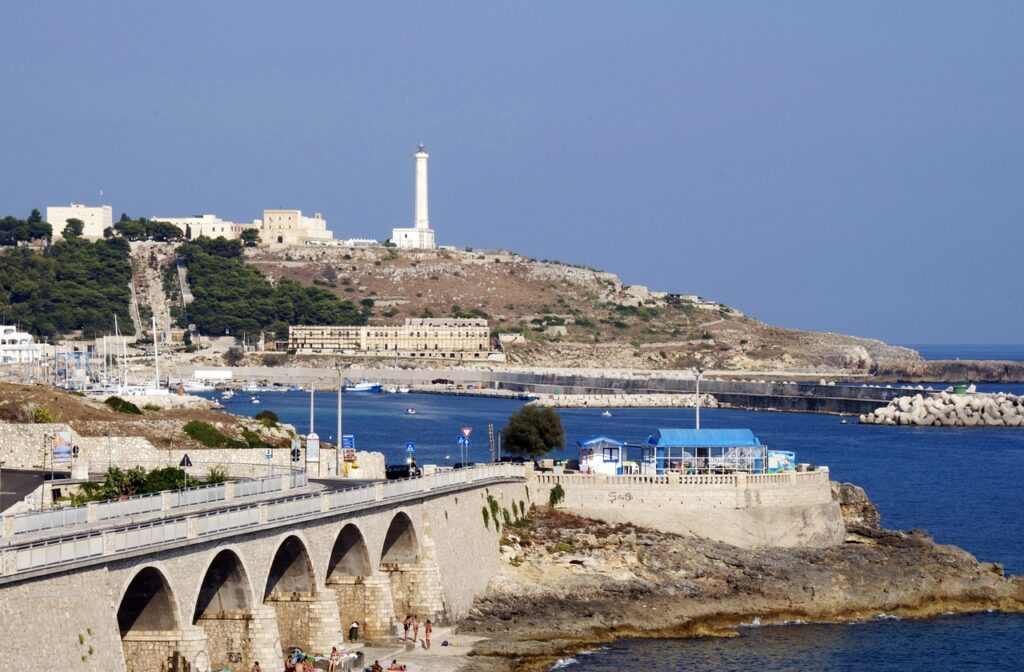
Finibus terrae, where the land ends. Leuca has been called this for centuries, because it was believed that the known lands ended here and the mystery began. We are at the extreme tip of the boot, the heel that launches into the sea and already looks towards other nations.
This position has made this stretch of Puglia a place of assaults and raids but also of trade and encounters with other peoples.
Phoenicians, Greeks, Messapians, pirates and Turks have passed through Leuca.
The name derives from Leukòs, white, to remember how Leuca also shines under the sun like many other cities in this part of Puglia.
About the name: you will hear it called Leuca, Santa Maria di Leuca or Marina di Leuca, as if they were three different cities.
In reality we are always talking about the same territory, even if those who ask about Leuca want to get to the ancient village, those who ask about Santa Maria want to go to the famous church, those who ask about Marina want to go and dive into the wonderful local sea!
However, many people get confused, so let’s clarify. Leuca is the name with which for centuries the town and the surrounding territory have been indicated. Santa Maria di Leuca, on the other hand, refers above all to the religious element: the cathedral of Finibus Terrae where, according to legend, Saint Peter stopped on his arrival from Palestine.
The church occupies the space that was of a temple dedicated to Minerva. Peter consecrated the church to Christian worship and since then this sanctuary has been considered one of the places to visit to reach Heaven.
The image of the Madonna with Child is by Giacomo Palma junior, a student of Titian. Next to the sanctuary is the Leuca lighthouse, 48 meters high and 120 meters above sea level. If you are lucky, you might find the Monumental Waterfalls of the Apulian Aqueduct active.
Finally, we have Marina di Leuca, the lower part of the town, famous above all for its urban beach, bars and nightlife venues. Obviously there is no shortage of beaches in the surrounding area: the first one you come across is Ciolo, a spectacular fjord overlooked by a bridge.
Then Torre Vado, with a kilometre of sand and the famous tower and finally Pescoluse, the Maldives of Salento, 4 km of crystal clear sea and white sand.
Gallipoli
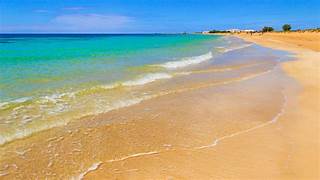
The “beautiful city” is truly a place of great beauty, you can admire the ancient village without haste, connected to the mainland only by a bridge, a village that almost floats on the sea. White houses, flower-filled alleys, souvenir shops make it one of the most beautiful seaside villages not only in Salento but in all of Italy.
Before accessing the bridge that leads to the ancient heart, it is right to stop at the Greek Fountain, considered for centuries the oldest public fountain in Italy.
As in Otranto, also in Gallipoli the protagonist of the architecture is the Castle that after years of semi-abandonment has returned to new splendor.
Since 265 BC the Castle of Gallipoli has seen the raids of all the peoples of the Mediterranean, until it assumed its current form in 1500, designed by Francesco di Giorgio Martini on behalf of Alfonso II of Aragon. In the Rivellino tower you can still see the cannons and catapults that defended the city.
The old town unfolds around the Gallipoli Castle, which can be enjoyed especially with the walk along the sea. The most important church in Gallipoli is the one dedicated to Sant’Agata, built between 1629 and 1696, and is the most representative monument of the Baroque style in Gallipoli.
In front of Gallipoli you can see the Island of Sant’Andrea, a nature reserve inhabited only by rabbits and Corsican gulls. Here, once upon a time, the inhabitants took their flocks to graze, while today people go there for an excursion into unspoiled nature!
The easiest way to enjoy the beaches of Gallipoli is to go down the steps that lead to the Spiaggia della Purità, or Puritate (named after the nearby Church of the Madonna della Purità) just below the old town.
The sand is not white and fine like in the surrounding area, but the dive with a view of the city is spectacular. A few kilometers to the south there are three of the most beautiful and famous beaches in Gallipoli: Baia Verde, Punta della Suina and Punta Pizzo.
Baia Verde is the beach that has made Gallipoli the destination of unbridled and limitless tourism: here you will find a succession of trendy beaches that organize aperitifs and DJ sets every day, non-stop. The sea is beautiful but if you are looking for tranquility, perhaps it is best to go further down towards Punta della Suina, another piece of the Italian Caribbean.
Not far away is Punta Pizzo, which is also part of the Regional Natural Park of Sant’Andrea Island and Punta Pizzo Coast, with turquoise water and scented Mediterranean scrub behind it.
Nardò
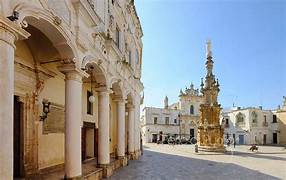
Nardò is perhaps not the first town that comes to mind when planning a holiday in Salento, and that’s a real shame.
Nardò is a small baroque jewel that competes with Lecce for the beauty of its squares, buildings and churches. The heart of the town is Piazza Salandra, which appears in dozens of films and commercials. In the centre of the square stands the 19-metre Guglia dell’Immacolata.
It was erected in 1769 as thanks for averting the danger of the earthquake. On the column, the statues in Lecce stone of San Giuseppe, Sant’Anna, San Gioacchino and San Domenico stand out, framing the Immaculate Conception.
The Palazzo del Sedile is the other great protagonist of the square. Built in the 16th century, it was the seat of the civic government. In the 18th century, the statues of San Gregorio Armeno, Sant’Antonio da Padova and San Michele, patrons of the city, were added.
To the right of the seat is the church dedicated to San Trifone. The Palazzo di Città with the Clock Tower closes the square. Nardò, just like Lecce, is a city of churches, almost all in Baroque style.
Not only the Cathedral dedicated to the Madonna Assunta, but also those of Santa Chiara, San Domenico, San Giuseppe and della Purità. Nardò is a city of beautiful noble palaces and villas, almost all of which cannot be visited.
But the most important civil monument is the Acquaviva Castle, now the seat of the Town Hall. Built in 1400, it has a quadrangular plan with 4 cylindrical towers at the corners.
From the old moat you can access the garden with a beautiful 19th century majolica gazebo garden. Also worthy of attention is the Osanna, a mysterious octagonal temple that should represent the victory of Christianity over paganism.
Among the beaches not to be missed in Nardò is Santa Maria al Bagno, a small beach and rocks famous for the “Four columns” that since 1500 defended the fresh water source from pirates.
Then the area of Santa Caterina with its cliff steps, Porto Selvaggio, woods, cliffs and marshes overlooking a crystalline sea and finally Sant’Isidoro.
Galatina
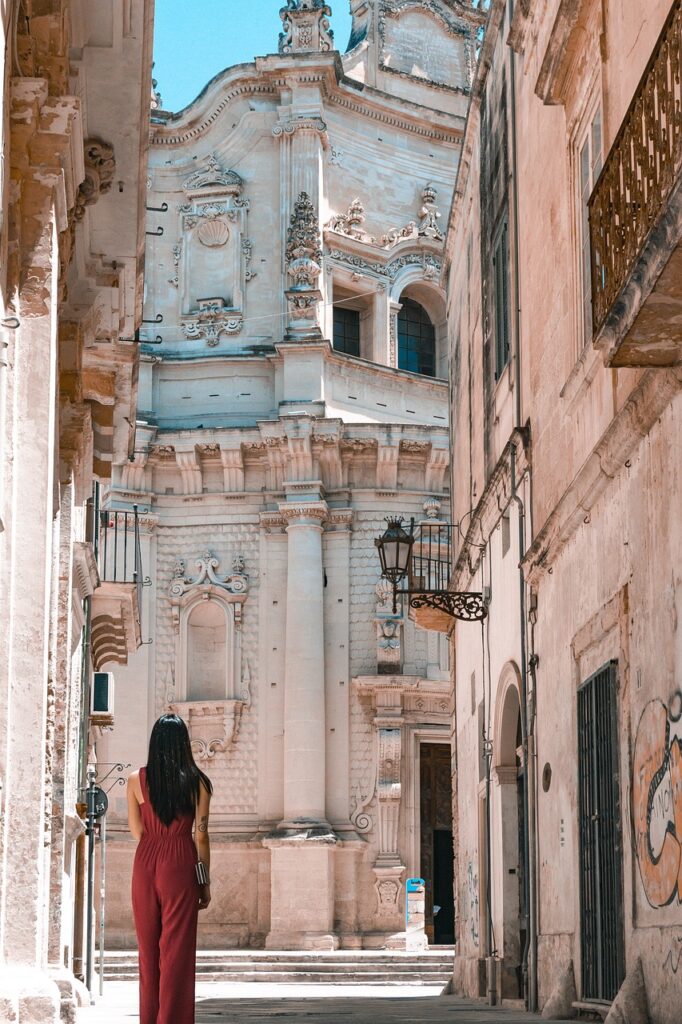
The splendor of Galatina is due to a single great family, the Orsini del Balzo, in particular Raimondello and his wife Maria D’Enghien, between 1369 and 1381.
The masterpiece of the family is the Basilica of Santa Caterina d’Alessandria that Raimondello wanted to build to house the relic of the finger of Saint Catherine of Alexandria that he himself brought to Galatina on his return from the Crusades.
The splendid Romanesque façade is decorated with a portal and a rose window announces the splendor of the interior. Just like in the Basilica of San Francesco in Assisi, every corner of the church is covered with frescoes made by the best artists of the Kingdom of Naples.
There are about 2,500 square meters of frescoes that represent Genesis, the life of Christ and the Apocalypse.
The section dedicated to the musical angels is absolutely not to be missed because it allows you to discover countless musical instruments used in the Middle Ages.
Don’t miss a visit to the nearby cloister, also entirely frescoed. Worth a visit are the Chiesa Matrice di San Paolo e Pietro, in the main square of the town, and the nearby Cappella di San Paolo, known as the “Tarantate”.
The chapel is located in via Garibaldi, under the eighteenth-century Palazzo Congedo. Here, in fact, according to legend, on June 29th, women bitten by tarantulas came to drink water from the chapel’s well and ask for grace to heal their illness.
For the rest, as in all the cities of Puglia, in Galatina it is nice to walk through the alleys, admire noble palaces and small shops, and stop at Pasticceria Ascalone, of course! Apparently, in the laboratory of this historic place that preserves the original furnishings, the famous pasticciotto leccese was born.
Porto Cesareo
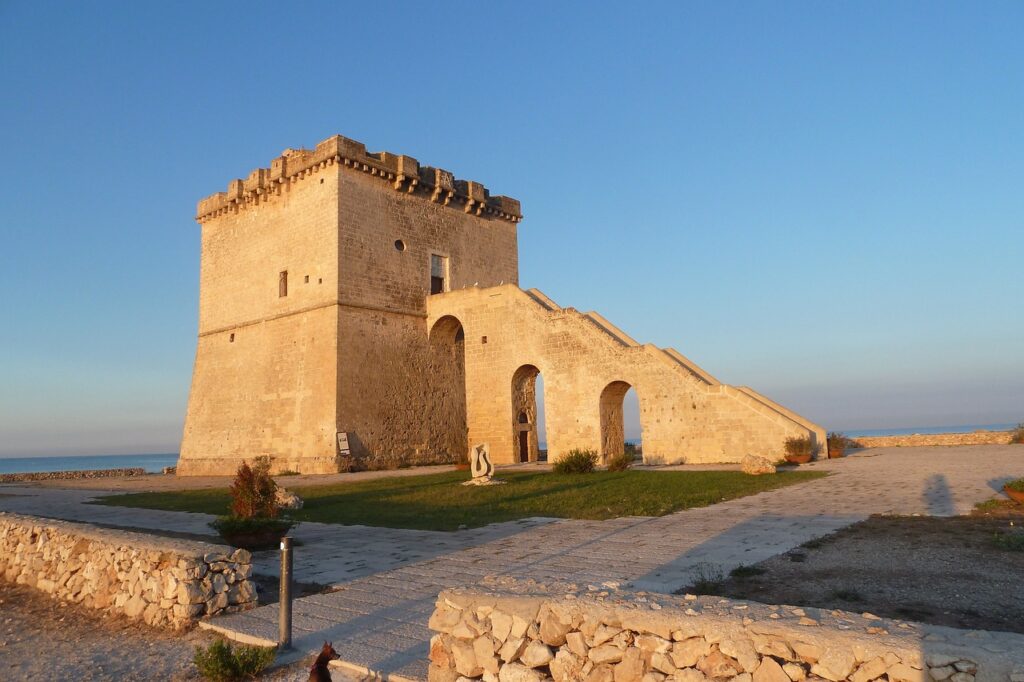
Our journey around Salento ends in Porto Cesareo, 17 km of low, sandy beach and crystal clear sea with some of the most beautiful beaches in Europe. All the life of the village takes place around the small port with colorful boats and the characteristic fish market.
Porto Cesareo comes alive especially in the evening, because during the day tourists divide along the two large rivieras. That of the Strea which is largely lagoon and that towards the west where there are some of the most beautiful beaches in the world.
You start from the port to get to Primo Ponte and Scalo di Furno. Here, if you have time, a visit to the protohistoric village of huts, surrounded by a wall about 2.5 meters high, is a must.
Immediately after is the Dune beach, one of the most suggestive and spectacular, with mountains of sand and crystal clear water.
You first encounter Torre Chianca, one of the four spectacular towers on this stretch of coast, and then Torre Lapillo under which 4 km of free beaches and lidos stretch. The sea of Porto Cesareo ends at Lido degli Angeli and Punta Prosciutto. A marvel with shallow and clear water, dunes and Mediterranean scrub behind, mostly with free access.